
Pointers on Choosing Metal Detection Systems
June 1, 2026
 How in the World Do You Write a HACCP Plan?
Writing a HACCP plan is a daunting task. If you’ve never seen one, or your company has never created this kind of document, it may seem like an overwhelming job. The FDA, USDA, and FAO, among many others, all offer helpful information and guidelines for putting together the necessary records that will demonstrate your Standard Operating Procedures (SOP), Prerequisite Programme (PRP), Critical Control Points (CCP), Quality Control Points (QCP) and other details. It’s pretty easy to get lost in the sea of acronyms. The FSIS provides a copious list that, even to the knowledgeable food industry expert, can appear overpowering.
Here are a few of the things a HACCP Plan includes:
- HACCP Team Identification: a list of all personnel involved in and/or responsible for developing, implementing, maintaining and documenting the plan.
- Process Flow Diagram: A diagram covering the full process, including a step-by-step outline from the intake of raw materials to final delivery, with all identified CCPs.
- Product Description & Intended Use: specific and comprehensive data/information about the food, its ingredients, processing methods, method and type packaging, storage details, safe shelf-life, and expected consumers.
- Hazard Analysis: Recognition of possible and probable organic, chemical, or physical risks at each step of production.
- Monitoring Procedures: Planned oversite and measurements to guarantee CCPs are within required limits, including rate for testing and responsible parties.
- Critical Control Points (CCPs): Classification of specific places, steps, or process points where control can be implemented to minimize and/or prevent, remove, or reduce a vulnerability to an better-than-reasonable level.
- Critical Limits: Max and minimum values (e.g., temperatures, humidity, condensation) that must be achieved to ensure the CCP is controlled.
- Corrective Actions: Detailed actions to be carried out when monitoring warns of a deviance from a critical limit, safeguarding unsafe product from being introduce to the marketplace.
- Verification Procedures: Actions, e.g. recorded evaluations and machine calibrations, to confirm the HACCP methods are employed effectually.
- Record-Keeping & Documentation: Thorough documentation of the threat analysis, the plan itself, monitoring logs, remedial actions, and audit results.
Since we (Regal Packaging Services) don’t manufacture, process or package any food products, we’re not required to have a HACCP plan, however, we go through a very similar process with our ISO certification.
Testrods.com, as a division of Regal Packaging Services has held ISO Certification since November of 2018. ISO stands for the “International Organization for Standardization and is an international standard development organization composed of representatives from the national standards organizations of member countries. [It] was founded on 23 February 1947, and … has published over 24,500 international standards covering almost all aspects of technology and manufacturing.”1
There are a wide variety of reasons ISO Certification is important. But what it really means to you, as a Testrods customer, is that we’ve taken the time to make sure our manufacturing and sales practices are trustworthy. It means we’re held accountable for the way things work both in our manufacturing, sales, and customer service. We test and retest products. When we send an order out, we know it meets the standards necessary for your success as it relates to food safety. And we acquire our materials from the right sources so we know they can be trusted on your behalf.
To ensure this is always true, there are 3 parts of our process that are crucial to keep our products safe for use in the marketplace:
Customer focus:
We have a written procedure for how we handle incoming orders, whether by phone, email or our website. Every order is handled using the same steps and is documented in the same manner. No customer’s order will be lost in a chaos of paperwork, regardless of its timing or arrival. That’s not to say that mistakes aren’t made, but they represent less than 2% of our volume. Less than 0.35% represent a issue with the manufactured product. And when an error does occur, we are quick to resolve the issue with 24-48 hours.
Process approach:
As an organization we understand that a desired result is achieved more efficiently when activities and related resources are managed as a process or series of interconnected activities. Our methods and procedures are designed to ensure that we send out consistent, quality, certified products. Every step of the manufacturing chain is well thought out and well supported. A series of checks and balances means we’re able to keep defective products off the shelf and out of the marketplace.
Improvement:
We had to achieving continual improvement across all aspects of our quality management system; it is one of our main annual objectives. We never assume that because we have been doing something a certain way that it cannot or does not need to be changed to produce a better result. We approach every day with an attitude that asks, “Can I do this better?” We are not afraid to find new suppliers or investigate new ways to make custom products to meet the needs of your specific application.
Evidence-based decision making:
As an organization we have committed to only make decisions relating to our QMS following an analysis of relevant data and information. We also never assume that what we “think” is happening is really occurring without checking the data to verify the accuracy of our thinking. We work to resolve anything that may appear puzzling on the surface before we make any change to a process or a material.
In the end analysis, we want to be absolutely certain we can say with confidence that what we deliver to you is exactly as good as we claim it is. When you’re using our products to test your equipment, you can be absolutely confident they are doing what they should.
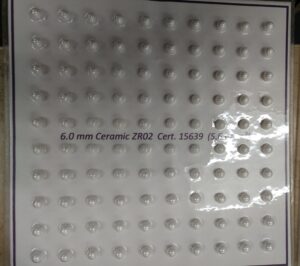
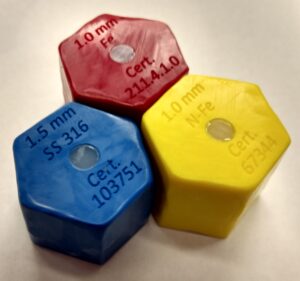
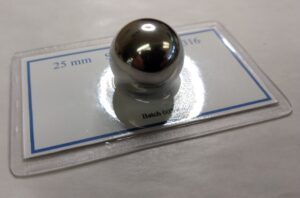
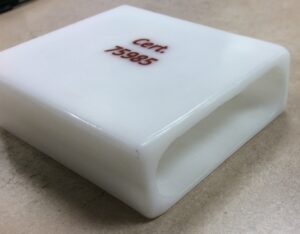
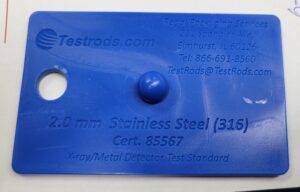
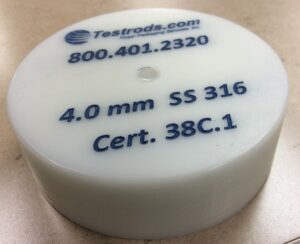
As stated on our certificates, “Regal Packaging Services Inc., as a supplier of set products, testifies that the balls used are certified as being accurate in size and type (Grade 200 or better) and are traceable to the NIST standard applicable for this industry. Each lot is verified to produce an appropriate metal detector signal proportional to the metal sphere size/type and detector phase settings. Each lot is also verified to attenuate the appropriate x-ray, proportional to the density of the metal sphere size/type and x-ray detector settings. The metal detector signal and x-ray attenuation produced from these products does not deteriorate over time and our certificates do not expire. All items are approved for food contact in accordance with the FDA, Title 21 CFR 177.2470 and 177.1630.”
Find out what makes us different when you order here on our website, or call us at 866-691-8560 or email testrods@testrods.com.
- https://en.wikipedia.org/wiki/International_Organization_for_Standardization