
How in the World Do You Write a HACCP Plan?
July 1, 2026
Making Great Test Pieces
May 1, 2026
 GUIDE TO CHOOSING A METAL DETECTOR
We’ve written before about some of the important points to consider when purchasing and operating metal detection systems, but it’s worth a more in-depth examination again, with some expert advice.
In an article in the Food Safety Magazine back in 2020, Steve Gidman, Founder and President of Fortress Technology, offered a few vital things to consider when implementing metal detection into your contaminant protection program.
While it may not be an exhaustive list, these things top the list of considerations:
- Contaminant detection: choose a kit that reflects the risk.
- Select inspection equipment with inbuilt record keeping capabilities
- Check that metal detection systems are failsafe
- Minimize false rejects
- Get compliant and stay compliant
In addition, you’ll need to think about:
-
Overall Equipment Effectiveness
Not only is there an initial investment in acquiring a metal detector, but you should study the service life and expected operating costs. Will you be able to upgrade your purchase if and when you need to, and how much “down-time” can you expect for normal service maintenance and repairs.
-
Future Compatibility
With metal detectors like those offered by Fortress Technology, future compatibility will never be a problem. Their guarantee is an indispensable backward-compatibility application that allows customers to upgrade any existing detector – even though it might have been manufactured 20+ years ago!
-
Waste Reduction
False rejects slow down a production line, waste valuable product, and categorically reduce profit. Retesting the isolated product is time consuming and impacts productivity. The primary reason for false reject is “product effect.” This is most common on lines producing ‘wet’ items. For product like dairy, meats and ready meals, and where disparities in density create a challenge for X-Ray, you need to look for a machine that delivers a dependable option for tackling product effect.
-
Signal Strength
Metal detector sensitivity is reliant on multiple components: size of the aperture, operating frequency, product speed and environment. Reducing aperture size is widely regarded as a simple and effective way to increase metal detector sensitivity. That’s because sensitivity is measured at the geometric center of the aperture. Considering the ratio of the aperture to the size of the product is a very important element to choosing the right machine for your product.
-
Adaptability to Changing Spaces
According to standard belief, detection equipment needs to be fixed in one location. However, a meat pump pipeline system, like the one offered by Fortress does not need to be secure to the floor or ceiling. It can be moved to whatever processing line needed. There, it can be linked firmly to vacuum fillers. Mobility makes it quicker and simpler to roll out and disassemble for deep cleanup. In some cases, you might consider a multi-aperture, multi-lane unit. A two-lane arrangement cuts the footprint by more than 50% and can decrease the total cost by over 65% long term.
-
Automatic Performance Verification
Automatic verification is particularly beneficial when access and placement or environmental conditions obstructs testing. Fortress Halo technology mimics (and frequently improves on) manual testing and increases test frequency. This quickly signals the operators to a possible test issue, appreciably minimizing the time during which a problem may go unnoticed. This decreases the number of suspicious products that have to be destroyed or recalled.
-
Equipment Care
How long industrial machinery lasts will depend on quality and manufacturing standards, overall design, plus how well it is used, maintained and cared for. Keeping scheduled maintenance and ensuring operators follow simple, documented hygiene practices and cleaning procedures will reduce wear and tear, as well as prevent cross contamination and allergen events. You should evaluate the ingress protection (IP) rating on equipment. In addition, inquire with the manufacturer to determine features like access ports, slide out access and ease of disassembly and reassembly for cleaning.
-
Integration with Other Equipment
Metal detectors are commonly incorporated with other apparatus, chiefly baggers and checkweighers. It is relatively straightforward to implement a single screen set up, joining all equipment together, developing a smaller footprint and an uncomplicated gathering of consolidated data. Sometimes, Multiple reject positions can even be designed for the various parts of the production line.
-
Traceability and Record Keeping
The benefit of common reporting standards is invaluable. Food producers today acquire large quantities of data from the production area. Technology can make certain the data is available, meaningful and meets due diligence requisites. Ask about an automated record keeper for authenticating all events, including rejects, performance authentication tests, settings/parameter changes and more.
Regal Packaging Services can give you all the help you need when it comes to:
metal detectors and checkweighers: 630-942-8461, regalpack@regalpack.com
auditing: 800-976-2390, inquiries@detectoraudits.com
rental: 866-982-4442, inquiries@detectorrentals.com
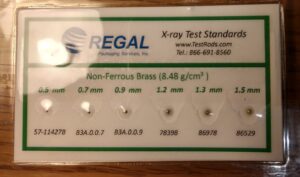
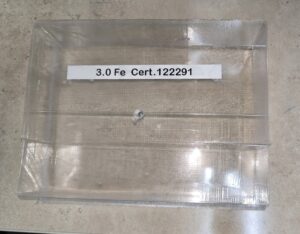
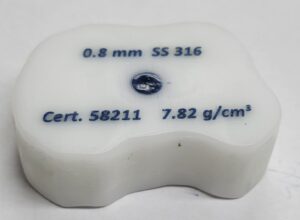
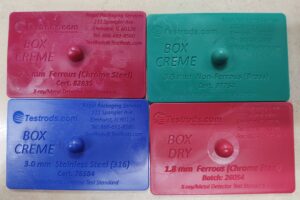
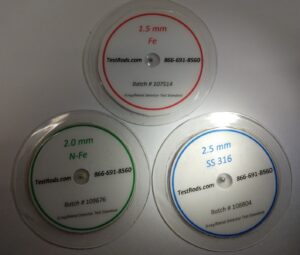
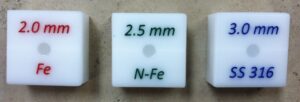
test pieces: 866-691-8560, testrods@testrods.com
Taken, in part, from https://fortresstechnology.com/what-to-look-for-when-buying-a-food-metal-detector/