Total Inspection Provider

Regal Packaging Services Is Your Total Inspection Service Provider

July 24, 2026


Total Inspection Provider

Regal Packaging Services Is Your Total Inspection Service Provider

July 24, 2026

Artificial IntelligenceIS THERE ANY USE FOR AI IN METAL DETECTION?

Masayoshi Son (founder and CEO of SoftBank Group) once said, “I believe this artificial intelligence is going to be our partner. If we misuse it, it will be a risk. If we use it right, it can be our partner.”

There are, of course, a plethora of opinions about the value and uses of AI, but the fact remains, nonetheless, that Artificial Intelligence is altering the way we do almost everything, and that includes metal detection in the food industry.  There is a move from conventional systems to techniques capable of adapting, absorbing and translating information to appreciably reduce false rejects and enhance detection sensitivity for smaller contaminants. AI enriches the ability to detect metal particles in demanding, high-conductivity products (like cheese or meat) and through metallic packaging. For businesses pursuing quality assurance at a higher level, the latest in AI technology delivers a host of innovations.

Key advancements and applications of AI in food metal detection include:

  1. Enhanced Metal Detection Capabilities

  • Reduced “Product Effect”: Traditional detectors have long been the backbone of food safety but can sometimes struggle with “product effect” – where wet, salty, or conductive food appears as a metal contaminant. AI learns to differentiate between the signal created by the product (analyzing product “fingerprints” so to speak) and actual metal, reducing false positives.
  • Smaller Contaminant Detection: AI algorithms are capable of identifying smaller, subtler metal fragments than conventional equipment, increasing sensitivity by utilizing multiple frequencies simultaneously.
  • Metallic Packaging Detection: AI enables reliable inspection even when food is packaged in aluminum or metallized film, which previously caused significant interference.
  • Automating and Enhancing Audit Checks: Hourly or other scheduled verification checks are an integral part of food safety compliance, but they can be tedious and subject to human error. AI-driven systems automate these tests, guiding operators step-by-step and logging results automatically. This streamlines the process and guarantees more accurate, consistent record keeping for regulatory audits. 
  1. Operational Efficiencies

  • Fewer False Positives/Rejects: By correctly recognizing contaminants, AI limits the unwanted rejection of safe food, reducing waste and saving time and money.
  • Real-time Adaptation: AI-powered systems continuously learn and fine-tune the process, adjusting to new product variations (e.g., changes in dryness or temperature) without needing constant labor-intensive re-calibration.
  • Predictive Maintenance: AI proctors equipment health in real-time, examining and analyzing data such as signal strength and energy usage to forecast potential breakdowns before they happen, thus circumventing unplanned downtime.
  • Operational Proficiency: “To assist … food processors, Fortress is already using its own proprietary data software package, Contact 4.0, across its metal detection, X-ray and checkweighing technologies,” said Eric Garr, regional sales manager, Fortress Technology. “This enables processors to review, collect data and securely oversee the performance of multiple Fortress metal detectors, checkweighers or combination inspection machines connected on the same network.” 
  1. Key Technologies and AI Systems

  • Machine Learning (ML) Models: These are trained on massive datasets of images or signal patterns (with and without contaminants) to learn what “good” product looks like, allowing the system to reveal and flag nonconformities.
  • Vision AI: In addition to magnetic detection, Vision AI utilizes cameras to recognize surface-level contaminants like hard plastic, wood, or glass that metal detectors would otherwise miss. Cutting-edge image analysis driven by deep learning can identify these non-metallic contaminants that traditional systems might miss. By dissecting X-ray images at a granular level, AI can discover irregularities that would otherwise slip through the cracks. Each AI model is an collection of many images of appropriate and objectionable products and substances.
  • Smart Checkpoints: Modern systems (e.g., from Fortress Technology rep Regal Packaging Services) feature automated testing (like HALO) that verifies system sensitivity without requiring a human to insert test pieces.
  • Microwave Technology: This is typically used to detect low density foreign materials like wood, soft plastics or fruit stone fragments in homogeneous liquid and semi-liquid products like sauces and purees. Antennas are situated around the product, so the microwaves infiltrate and inspect the entire product. Variations in the electric field reveal contaminants, and when united with Artificial Intelligence (AI) algorithms, these technologies can identify which type of contaminant is present using 3D reconstruction. Microwave is less energy intensive and does not heat the product, which helps preserve finished product integrity. 
  1. Benefits for Food Manufacturers

  • Improved Safety: Enhanced detection of ferrous, non-ferrous, and stainless-steel contaminants protects consumers.
  • Reduced Recalls: Increased accuracy reduces the likelihood of contaminated products reaching the market.
  • Compliance: AI systems help meet stringent HACCP, IFS, BRC, and FDA standards.

While AI is a powerful tool, experts note that it is not a complete replacement for human oversight but rather a tool to augment it, requiring high-quality training data to be effective. Humans will always need to oversee the training, competency and outcomes of AI assisted metal detection. And humans, of course, will always bear the responsibility for the results.


Material taken, in part, from:

https://www.foodregulationcanada.com/top-5-ways-ai-is-revolutionizing-food-safety-inspections-blog-post/

https://www.bakingbusiness.com/articles/64224-using-ai-for-a-more-intelligent-approach-to-food-safety

https://www.kpmanalytics.com/resources/categories/resource-center/ai-for-food-quality-safety-what-works

https://www.profoodworld.com/food-safety/inspection/article/22952663/the-real-role-of-ai-in-food-inspection

https://oxmaint.com/industries/fmcg/ai-foreign-object-detection-food-manufacturing

https://www.checkfirst.ai/blog/ai-workflow-automation-for-certification-leaders

https://www.dairyfoods.com/articles/98828-how-does-ai-improve-food-safety-by-catching-defects-before-they-reach-customers

https://fortresstechnology.com/future-proofing-food-production-with-all-in-one-inspection/
 

Leave a Reply

Your email address will not be published. Required fields are marked *


Some applications involve large tubs, vats, or some other type of product travel where it would be nice to have a test piece that floats. Once again, our thermoform cards provide the simplest solution. We simply insert some type of structure that forces the thermoform card to retain air, which, of course, is what makes it float. We have also manufactured floating rods, which are more difficult because there is less space to close in enough air to make the rod float but is doable.

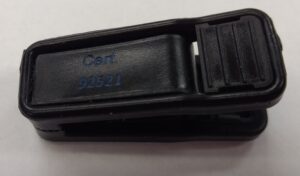
We took an ordinary plastic “chip clip” as defined by the customer and embedded the contaminant into the clip. The clip can be attached to the product on the line without damaging or opening the product for testing purposes.

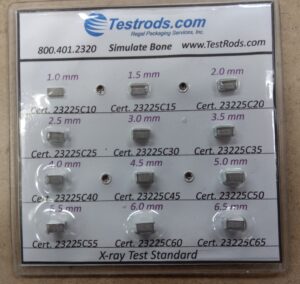
Bone is a difficult contaminant to find because it can vary widely based on the size, age, and calcium content (as well as feed used) of the animal. After working with several customers, Regal Packaging Services offers Pork, Beef and Chicken Bone Simulate. We have a small range of sizes at a variety of depths to simulate whatever you might expect to find in the product. Our recommendation (assuming your x-ray has visual display) is always to start with a multi-card. Using a multi-card gives you an easy way to test several sizes and depths to determine what matches the bone you’re using. Once you’ve made a comparison, testing the card against the bone you’re looking for, you can purchase a card with a single contaminant for regular testing.

This small pill shaped test piece is used in a system with a vacuum tube that shoots the test piece through the aperture and returns it to the “home” base. Your system may never be like it, but the point is that we can make a customized solution no matter how unusual or impossible it might seem.

As you may have seen in some of the other thermoform card descriptions, we can put nearly as many seeds as you can imagine on a single card. Pictured here you will find a wide variety of configurations and contaminants. Just let us know your specs: size of the card (up to 8” x 8”) along with size and type contaminant(s) and we’ll get you a quote as quickly as possible. Working with a multi-card is especially helpful when you are looking for multiple types of contaminants or when you want to determine what size of the same contaminant you are able to detect. In that event, once the size is chosen, you can order individual card(s) for regular, standard inspection and detection.

There are a wide range of applications that require a test piece much longer than our standard 5” or 6” Testrods. We can make up to 3/8” x 34” or 1/2” x 34” rigid test pieces which can then be extended well beyond that length with a “handle” made of acetal cylinder larger than the 3/8” or 1/2” extension. In the photos, we used a 1” x 24” cylinder handle with a 3/8” x 24” inch extension.

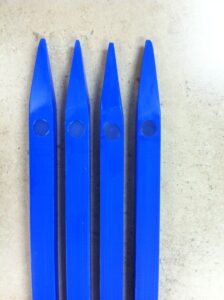
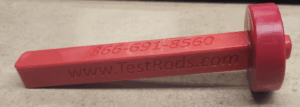
Test pieces can be made in a variety of sizes and given a pointed end in applications that require the contaminant (metal) to be inserted into a food package such as sugar or some other soft packaged food product. This allows the metal to reach the center of the aperture.

Double-End Test Whips are also available, with metal in both ends. One consideration is to make certain that the whip is long enough to keep the metal on the non-testing side of the whip outside the metal free zone of your detector. If you insert, for instance one end of a whip with 2.0mm and 3.0mm Ferrous, you need to make certain that the 2.0mm metal doesn’t affect the detection of the 3.0mm metal (and vice versa). If the 3.0mm metal is inside the metal free zone, then the detector will be reacting to the 2.0 as well as the 3.0 as if they were combined.

Multi-seed laminate test cards are designed for seeds 4.0mm or less. Multi-cards are useful in x-ray inspection to determine what sizes and types of contaminants your system can achieve. They can be especially useful in temperate environments and applications. If your application is rugged or wet, or your standards are larger, we recommend our thermoform multi-cards.

We can simulate a variety of packaging in an application where you need the test piece to mimic what is traveling down the production line. In this case, we manufactured a clear “package” with the seed inside. With this method, the customer is able to reject the container appropriately, and, in the event the package is not rejected, it is easily seen by the line worker for manual removal.

There are two types of “candy bars” pictured here – one similar to a flat candy bar and the other in a custom, near perfect copy of a candy bar. Since we’re now able to produce many variations using colored material, the copy was made in red (Fe), green (NFe) and blue (SS 316). We have the equipment to accomplish nearly anything you can imagine, and these kinds of designs are proof positive.

Need a test piece that looks and handles like chicken nugget? We can do it. Interestingly enough, in this situation, our first version for the customer left too much “void” in the hole where the metal was placed. Given the sensitivity the customer system was using, the void had the effect of causing false positives. We were able to minimize that hole and supply the test piece with almost no void. It’s an example of how we can work with you before, during and after manufacturing to ensure all the specifications were met.

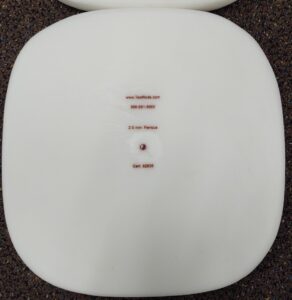
Our standard acetal card is 2 1/4"x3 3/8,” but if needed, we can cut that size down to as small as 1 1/4” x 1 1/4” (with limited engraving). If a larger card or a card with multiple seeds is needed, see our Custom Shape-Size Blocks and Tablets.

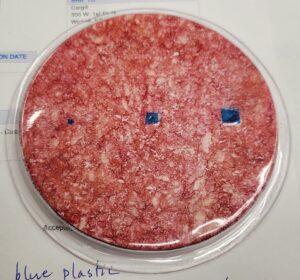
This distinctive test piece was created to mimic an actual hamburger patty. The customer supplied photos of the raw product, which we were able to reproduce and then we placed blue glove contaminant. Using this configuration, the customer was able to determine what size piece the vision scanning system could detect with the raw burger as the background. Had they simply used a blank card with the glove, the system could easily have achieved contaminant rejection, but they needed to be sure the system could “see” the blue against the product itself.

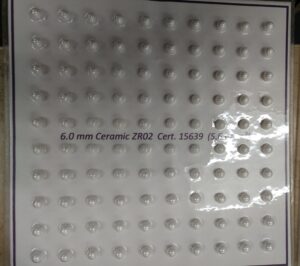
A card with 100 seeds in a 10x10 configuration is used to place beneath whole chickens on a production line. This gives the x-ray system operator the ability not just to see IF the equipment can detect the metal in the card, but also WHERE the equipment can detect it. If there is a problem, the operator (or company) can make any changes necessary to achieve the end goal – safe chicken in this case. This card really highlights another valuable facet of our thermoform cards.

In this scenario, a company processing sugar needed to have a “bag” simulated with the same weight in order to accurately fall through the reject mechanism. A lighter test piece had the risk of passing over the reject mechanism.

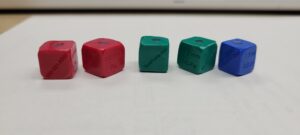
Our standard cubes are 1” and 1.5,” but we can also manufacture other sizes if needed. The cubes shown here are 1/2" in dimensions. Cubes can be helpful in applications where a ball or cylinder may bounce or roll away during testing, making their retrieval difficult, or, in some cases, present a hazard to the product or production equipment.

This is a test piece that is dropped into a bottle. It’s designed so that the metal appears in the center of the aperture when testing the metal detector. In addition, the round stop makes the test piece easily removable after testing.

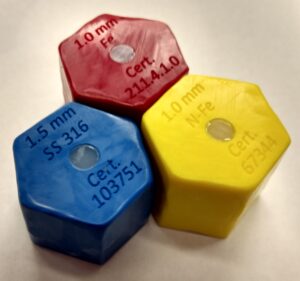
Hexagonal Shaped test pieces can be very useful in places where a cylinder or ball might roll or bounce around a production floor whether dropped by a line worker or ejection from a reject mechanism. Hexagons are similar in weight to the 1inch cylinders without having the smooth, rounded cylinder edge.

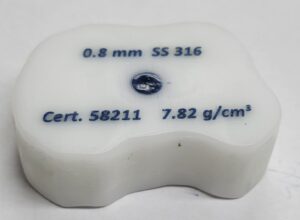
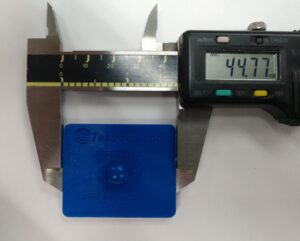
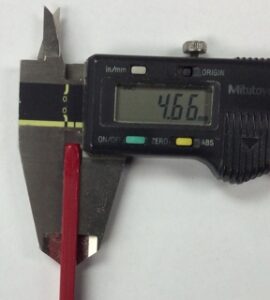
Our customer in this plant needed a test piece with a thickness less than 5.0mm. Because we have the capacity to customize sizes and shapes, we were able to mill down a product that met their specifications. That’s always our goal, meeting the specs you need for your product, testing environment and contaminants.

There are some applications (e.g., metal detection in lumber) that require large seeds. We could put the seed (ball/contaminant) in a large rod or block, but the thermoform card presents a simple, durable, and lightweight solution. The capacity for manufacturing using our thermoform (PETG) system makes it possible to encapsulate nearly anything you can imagine.

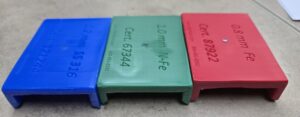
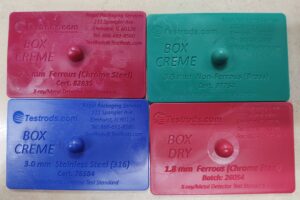
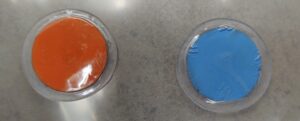
We can custom cut nearly any shape needed to fit your application. At times, you may want the test piece to look like your product in its raw form or after packaging. In many instances, we can supply the standard colors for ferrous (red), non-ferrous (green) or stainless steel 316 (blue) used in food and other industries. If your project is larger than 1” in thickness, we can always manufacture in white and color the letters.

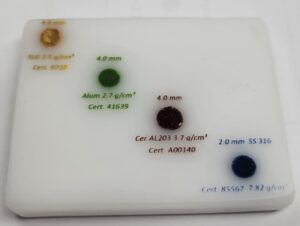
This flat tablet or card with multiple seeds and a diagonal configuration is used for x-ray inspection. The various contaminants are different densities and represent the type contaminants that might appear in the end product. We can manufacture a broad array of sizes and thicknesses with as many contaminants as needed for testing your x-ray inspection equipment.

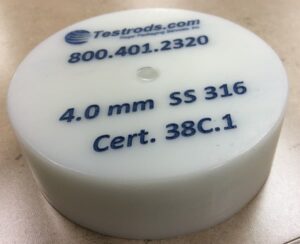
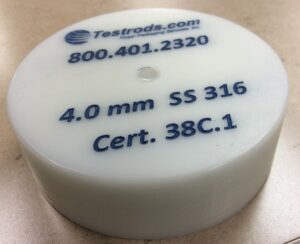
Sometimes a cylinder or “puck” is needed to mimic product shape moving down the line. We’re not limited to any particular shape. Pucks can range from 3/4" all the way up to 8.” So, if you’re running hamburgers or some other puck shaped product, this may be the solution you need.

In applications where the test piece needs to be identified for use on a particular production line or have some other type note regarding its use or placement, we can easily accommodate a wide range of types as specified by our customers.

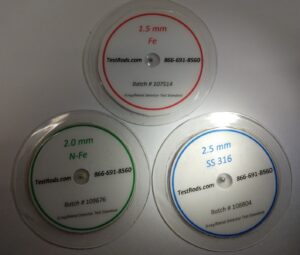
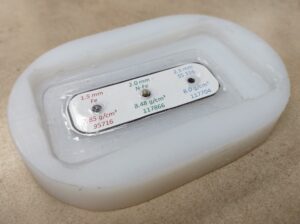
There may be a reason your application requires a different shape laminate card. We can manufacture a number of shapes like the circular one shown here, but particularly in square and rectangular sizes smaller than 2.5” x 4.25.” We can also manufacture larger sizes as well, if needed.

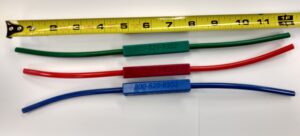
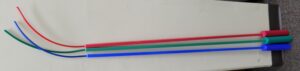
In this example, the Testrods team manufactured a 5-foot test piece with a “whip” end for use in an overhead application. With the flexible end, our customer found the test piece well suited for a difficult-to-reach spot on the production line. Test pieces like this can be made in a variety of lengths with the whip being as short or long as needed.

There are a wide range of applications that require a test piece much longer than our standard 5” or 6” Testrods. We can make up to 3/8” x 34” or 1/2” x 34” rigid test pieces which can then be extended well beyond that length with a “handle” made of acetal cylinder larger than the 3/8” or 1/2” extension. In the photos, the customer also needed the hole opposite the metal end for use in hanging the test pieces in convenient location for regular testing.

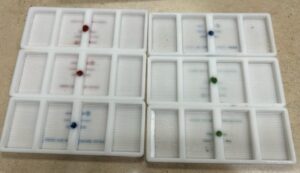
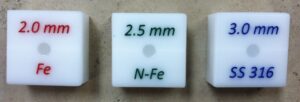
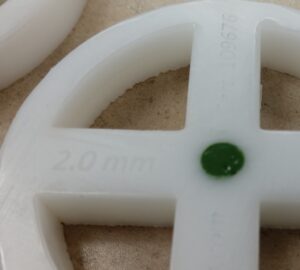
Pictured here are white blocks 1.5” L x 1.5” W x 7/8” T. We have the capacity now to offer this item in colors appropriate to the type metal (Fe-Red, NFe-Green, and SS316-Blue). You can select nearly any variation in dimensions, though there are limitations to the colored material. The colorant used for lettering on white test pieces is not guaranteed to last over the life of the test piece, however, it is food safe and does not present a problem on a food production line. We make it standard practice now to color the dot (where the metal is and not shown here), and the colored dot is guaranteed to last.

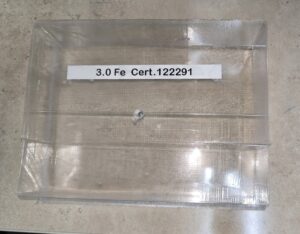
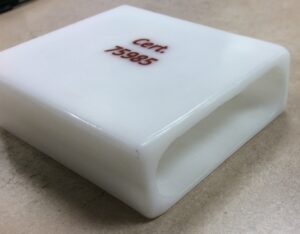
This hollow box represents or mimics the shape of a product box. The customer was normally emptying the contents and inserting a test piece for passing through the metal detector. The box, would, of course, wear down and tear after numerous uses. By creating the box using acetal (plastic), both of these issues were resolved. These kinds of product simulates can be created for whatever your application may require.

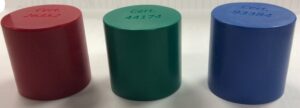
Standard cylinders are 1” in diameter, 1” in length, but we have the capacity to manufacture 1.5” x 1.5”, 2” x 2” or a variety of other sizes such as 1.5” D x 2” L. On occasion, we have made the 1” D cylinder in longer lengths as well.

This was a very unique product simulate both in design and metal placement. The “ice cream bar” had 3 locations for each type metal (ferrous, non-ferrous, and stainless steel 316), the leading, middle, and trailing edges. A difficult testing process was made simple, which is always one part of the goal.

One (or more) holes can be positioned on Acetal Cards so that a metal free lanyard or other type retrieval or hanging attachment needs to be added. The hole can also be used for hanging the test piece on a hook of its own.

Sometimes a cylinder or “puck” is needed to mimic a product shape moving down the line. We’re not limited to any particular shape. Pucks can range from 3/4" all the way up to 8.” So, if you’re running hamburgers or some other puck shaped product, this may be the solution you need.

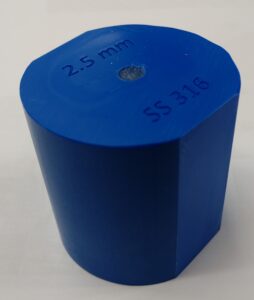
In this instance, the customer wanted a 2” x 2” Cylinder with flat sides, which, of course, means it’s not really a cylinder. But by cutting the sides, it means the test piece can be used as if it were a cylinder without the nuisance or danger of it rolling along the ground if dropped by hand or along the production line. These kinds of shapes can be designed and manufactured as needed for whatever your application may require.

As referenced in our “3" x 1" Puck Test Pieces” listing, we can not only make the puck shaped test piece with a “tray” for placing (in this case) a multi-card. Should different standards be needed for another (or a new) product, the test piece in the tray can easily be swapped out for varied sizes or other contaminants.

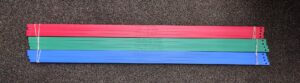
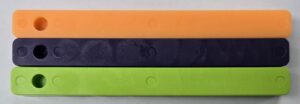
We now carry our 5” Testrods in construction orange, high vis green and dark purple. So, if you’re looking for something that will stand out against your product, consider one of these 3 new colors! Only available by custom order (email testrods@testrods.com or call 866-691-8560). Not available here on the website.

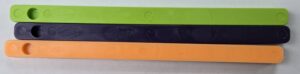
We now carry our 6” Testrods in construction orange, high vis green and dark purple. So, if you’re looking for something that will stand out against your product, consider one of these 3 new colors! Only available by custom order (email testrods@testrods.com or call 866-691-8560). Not available here on the website.

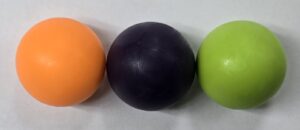
We now carry our 1” Test Balls in construction orange, high vis green and dark purple. So, if you’re looking for something that will stand out against your product, consider one of these 3 new colors! Only available by custom order (email testrods@testrods.com or call 866-691-8560). Not available here on the website.

Thermoform cards are useful not only in x-ray and metal detection, but also when working with vision systems. In this instance, the customer wanted a card with two distinct colors of latex gloves. This would allow them to determine if the system could capture/reject any product with all or just part of a torn glove. All kinds of material can be put in a card like this. All you need to do it is send us the material you need to capture and we’ll put it in a card for you!

Though this test piece doesn’t look like a cookie, it does match the outer shape and size of the customer’s product. In addition, the weight of this test piece needed to match the average weight of a cookie at 43 grams. We were able to remove material and accomplish each part of the challenge.

High Vis Laminate Test Cards are useful in an environment where the standard color might be difficult to see and capture in a product of similar color. High Vis cards can be made in red, green, blue, neon: yellow, pink, green or orange.

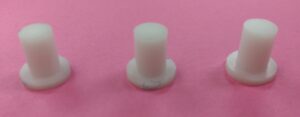
This test piece was designed for a pharmaceutical application. It could be placed in the top of a small bottle and easily removed as needed after testing. This eliminated the need to drop a testing seed into the bottle and then attempt to recover it after testing. And because the test piece was made using our standard acetal (plastic), it could be used nearly an unlimited number of times.

Our customer in this plant needed a test piece with a thickness less than 5.0mm. Because we have the capacity to customize sizes and shapes, we were able to mill down a product that met their specifications. That’s always our goal, meeting the specs you need for your product, testing environment and contaminants.